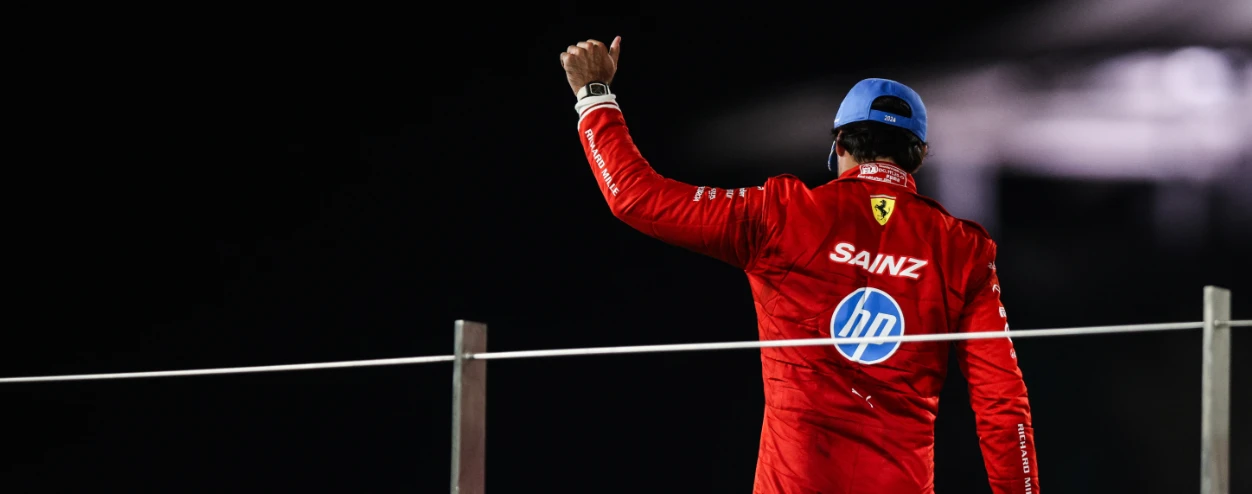




The upcoming 2025 Formula One season will be the proving grounds for many drivers getting their first taste of F1 action. So many new names are stepping up to the pinnacle of motorsport, eager to show that they're the stars to one day replace their new peers. For Carlos Sainz, though, he's already achieved what these rookie drivers dream of by winning races for Ferrari. And yet 2025 sees Sainz, not the newcomers, possibly facing the most crucial time of their career as he switches teams.
It's fascinating to see Sainz heading from contending for the Constructors' Championship with Ferrari to the back of the grid at Williams. The two teams are long-lived legends of the sport, but their current fortunes are worlds apart. Ferrari bounced back from the doldrums of 2020 to mount a title fight with Frederic Vasseur's new leadership. Williams, however, seemed to make two steps forward under James Vowles in 2023 before falling back last year. Each might have an illustrious history, but only one can hope for wins in the immediate future.
Seeing the online and media discourse around the Sainz partnership with his new employers shows how well-regarded the Spaniard has become. People pity Sainz and feel he deserves better. By comparison, many would've loved to have seen Franco Colapinto extend his time at Grove, while others hoped Valtteri Bottas could find a home with his first team. They'd be deemed a well-earned seat for Colapinto or a steady pair of hands for rebuilding with Bottas. Williams would somehow be the right level for either racer. For Sainz, however, going from Maranello to Grove is widely viewed as a backward step.

With Sainz leaving Ferrari after the best season of his career, there's little wonder why. Two race victories, one of which came after bouncing back from appendicitis, and seven further podium finishes left the 30-year-old man from Madrid with a personal-best 290 points. Had he made the Saudi Arabian race, the potential extra points he could've scored for the Scuderia might've tipped the scales of the teams' title. If a driver is only as good as their most recent season, Sainz is one of the best names in the sport right now.
Did Sainz Deserve Dropping from Ferrari?
Whether Sainz is hot property or not, there's an unquantifiable allure about Lewis Hamilton. The seven-time champion looks like his best years may be in the past, yet there's no denying his shock switch from Mercedes to Ferrari was the biggest F1 news of 2024. Even though 2021 was when he last had the consistency in himself and his car to fight at the front, only Max Verstappen would be safe in his drive if Hamilton came knocking.

Sainz has always played second fiddle to Charles Leclerc in the Ferrari politics, too. Leclerc is a long-time Scuderia-backed driver from his junior career days, and the man Maranello hopes to boast of as their homegrown hero. With Hamilton's history of working with Vasseur in GP2 and the magnetism of Ferrari before he one day retires, Sainz was simply in the right place at the wrong time. In short, there's nothing he could've done to have had a stay of execution in Italy.
Ironically, the closest thing I can remember to a well-performing driver having the writing on the wall for their future, irrespective of their form, comes at Sainz's new home, Williams. 1996 world champion Damon Hill spent much of his title-winning campaign knowing he wouldn't remain with the team that brought him to championship success. Sainz didn't quite reach that level, but he also didn't have the conquering force of the FW18 to propel him as high up the standings.
Hill headed to the back after his employers no longer required his services just as Sainz is about to in 2025. It was to the minnow team Arrows for the Briton, who coincidentally finished in P9 in the '96 standings just like Williams managed in '24. Yet the similarities stop there. Reportedly, Hill twice turned down the chance to drive for McLaren in favor of the financial package Arrows offered, but McLaren became the team to beat by the late 90s. Hill favored short-term gain rather than long-term potential. Sainz is walking a very different path.

Pay vs Potential
There's no way to know what pay packages teams offered Sainz for his 2025 signature, but it's not groundbreaking news to say Williams is not the richest player in the game. After Ferrari's dropping of Sainz, the privateer team went up against the might of Audi and Renault, two manufacturer-backed outfits, in the hunt to get their recruit — and they won. Audi, in particular, has the metaphorical bloody nose in the three-way fight for Sainz's services. Like Williams, they are in a foundation-laying phase for 2026, but the German giant's deep pockets couldn't lure their top target.
Audi is looking to shake up the F1 landscape when they enter 2026 with multiple years of preparation behind them. Yes, the current Sauber outfit is at the back, but they hope that their leadership changes will turn that around. Alpine, meanwhile, is going through another management change-up that saw an all-new Team Principal reach F1 and the return of contentious figure Flavio Briatore. All of this has come in the past six months, too. That's a lot of inconsistency for future building.

Williams, meanwhile, stumbled and crashed through 2024 and only scored points on five race weekends. So why head to the Oxfordshire team? You can only speculate, but Williams putting Team Principal James Vowles in what appears an immovable position for a long-term project is the clearest difference between the three teams.
Vowles took the reins at Williams in 2023 and immediately broke the mold of how to run an F1 team. Rather than promise that results were just around the corner, be it with the next upgrade package or the subsequent season's car, Vowles went all in on the 2026 regulation change. He's openly and repeatedly stated that he's pinning all the team's hopes on the future, not the present, and - vitally - he has the backing of Williams' owners Dorilton Capital to do so.
Sainz's 2026 Gamble

Had Sainz signed with Audi or Alpine, he would be working for a different boss than the one he would've agreed to drive for in 2024's summer. Rather than following Hill's footsteps and getting a better pay packet to stay in the sport, Sainz instead gambled on the foundations of Vowles' vision. Whether that's a smart bet will only become clear in the coming years.
It's undeniable that Vowles was extremely fortunate that no front-running teams were in the hunt for Sainz's signature. Equally, had Hamilton's patience at Mercedes lasted for another season, Sainz would not have considered leaving Ferrari voluntarily for the Williams project. Nonetheless, Vowles getting Sainz to buy into his (and it is his more than Williams') 2026 project over the possible futures at Audi and Alpine is a coup. Now Vowles has to make it work.
That’s where the risk lies for Sainz. Perhaps he picked what he deemed the least bad option of three terrible choices rather than F1's best potential, but his career now rests on a knife edge. As frustrating as it may be, 2025 will be a wasted year of the Spaniard's life, but he at least remains in the sport while others like Bottas and Daniel Ricciardo fade away.

If Vowles' grand plan for the new regulations fails to deliver, the memories of Sainz being a top-tier driver will be years in the past by then. Like Bottas picking up podiums or Ricciardo's years of “shoey” celebrations, F1 is a fickle place where Sainz's Ferrari heroics will soon be forgotten. All the while, a host of exciting new prospects, most of which are making their full-season debut in a matter of weeks from now, will have made names for themselves.
But maybe, just maybe, Sainz could be back at the front before you know it. Vowles' strategic genius took Mercedes and Hamilton to 14 combined titles. If his strategy calls for running a team match those he made from the pit wall, then Williams could be a waking giant by next year with Sainz leading the charge. Don't write Sainz off just yet.